


Rajasthan road trips are the kind of travel experience that people talk about for years. A golden fort appearing on the horizon through a dusty windshield. Peacocks crossing an empty highway at dawn. The smell of chai from a roadside dhaba in the middle of nowhere. The moment a camel sits down next to your parked car and looks at you with complete indifference.
But planning a Rajasthan road trip for the first time feels overwhelming. The state is massive. The cities are spread across hundreds of kilometres. You do not know which route makes sense, how many days you actually need, or what you will miss if you skip something.

Most people fly into Rajasthan, rush between cities, and leave without understanding what they actually experienced. A road trip changes that completely.
The road network in Rajasthan is well-developed. National Highways connecting all major cities are maintained, well-lit, and clearly marked. Driving here in 2026 is significantly more comfortable than even 5 years ago.
This is the question every first-time visitor asks. The honest answer depends on how many cities you want to cover and how fast you want to move.
7 Days: Covers 3 to 4 cities. Best for travelers with limited time. The Jaipur to Jodhpur to Udaipur triangle is the most popular 7-day circuit and makes for a genuinely satisfying trip.
10 Days: The sweet spot for first-time visitors. Covers 5 cities comfortably, typically Jaipur, Pushkar, Jodhpur, Jaisalmer, and Udaipur, with 2 nights at most stops and proper time to breathe.
14 Days: The ideal duration for a complete first Rajasthan road trip. Adds offbeat stops like Bundi or Kumbhalgarh. Rest days are built in. No rushing. This is what we plan in detail below.
21 Days: For those who want the whole state, including Shekhawati, Bikaner, Chittorgarh, and wildlife parks. An exceptional trip if you have the time.
The route below is designed as a loop starting and ending in Jaipur. This keeps the trip simple because you fly in and out of the same airport. The route moves logically from east to west to south, covering the most iconic destinations without unnecessary backtracking.
Jaipur to Pushkar to Jodhpur to Jaisalmer to Udaipur to Kumbhalgarh to Bundi to Jaipur
Total driving distance: Approximately 1,400 to 1,500 kilometres over 14 days.
This route balances famous cities with offbeat gems, desert landscapes with lake towns, and fort architecture with natural scenery.
Day 1 and 2: Jaipur – The Pink City
Drive from: Delhi via NH48 (270 km, 5 hours) or fly directly to Jaipur airport.
Jaipur is the starting point for most Rajasthan road trips. As India’s first planned city and the state capital, it has excellent infrastructure, great food, and no shortage of things to do for two full days.
Day 1 – Forts and Palaces:
Start at Amber Fort before 9 AM. The fort sits on a hilltop above the Maota Lake and the reflection of the pink sandstone in the still water below is the image most people picture when they think of Rajasthan. Take the jeep up or walk. Inside, the Sheesh Mahal (Hall of Mirrors) is covered with thousands of tiny mirrors set into plaster in intricate patterns. A single candle flame, reflected endlessly in every direction, fills the entire room with light.
After Amber, drive to the City Palace in the walled old city. The museum inside holds one of Rajasthan’s finest collections of royal artifacts, miniature paintings, and textiles.
Day 2 – Old City, Markets, and Views:
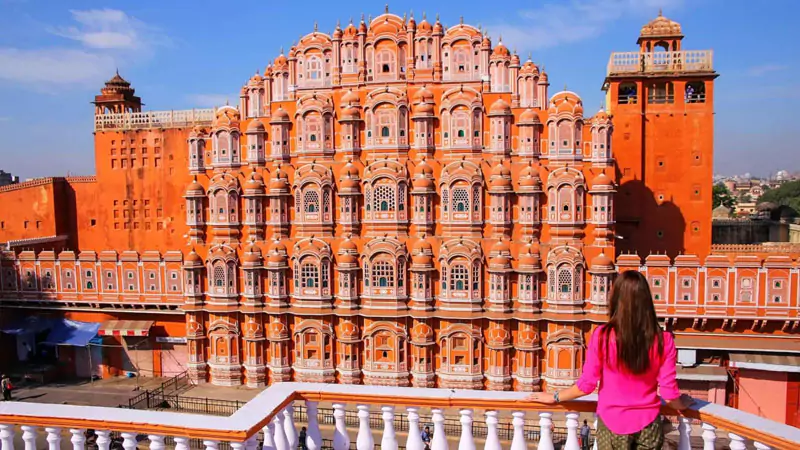
Morning at Hawa Mahal. The five-storey pink sandstone facade with 953 small windows is best photographed from the tea stall across the road. Then walk through Johri Bazaar and Bapu Bazaar. Jaipur is famous for gemstones, block-printed fabrics, blue pottery, and lac bangles. Whether you shop or just look, the colour and energy of these markets is completely absorbing.
Evening at Nahargarh Fort on the hill above the city. The view of the entire Pink City spread below at sunset, with the other Jaipur forts visible on surrounding ridges, is the best panorama of the trip’s first leg.
Driving distance to next stop: Jaipur to Pushkar: 145 km, approximately 2.5 to 3 hours.
Day 3: Pushkar – The Sacred Lake Town
Pushkar sits beside one of India’s holiest lakes, surrounded by low hills, and lined with 52 bathing ghats and 400 temples. It is one of the few towns in India dedicated to Lord Brahma.
The pace here is slow and the atmosphere is completely different from Jaipur. Walk the main bazaar street in the morning when the light is soft. Visit the Brahma Temple early before the crowds. Watch the evening aarti at the ghats as priests float oil lamps on the water and the sound of bells carries across the lake.
Pushkar works perfectly as a single overnight stop. It resets the pace between the busy Pink City and the Blue City ahead.
Driving distance to next stop: Pushkar to Jodhpur: 200 km, approximately 3.5 to 4 hours.
Day 4 and 5: Jodhpur – The Blue City
The drive from Pushkar to Jodhpur takes you through a landscape that grows increasingly arid. By the time you reach the city, the sky feels bigger and the air feels drier. Then the fort appears.
Mehrangarh Fort is arguably the finest fort in Rajasthan. Built by Rao Jodha in 1459 on a sheer 125-metre rock face, it has never been conquered. Walking through its seven gates, each built to commemorate a victory in battle, you feel the weight of that history. The museum inside has seven distinct sections covering royal palanquins, weapons, paintings, textiles, and the extraordinary howdahs used to carry royals on elephants. Give Mehrangarh a minimum of 3 hours.
From the fort battlements, the view of the old city below is the image that defines Jodhpur. Thousands of blue-painted houses spread from the fort walls to the horizon. The blue was traditionally used by Brahmin families but the entire old city gradually adopted it.
What else to do in Jodhpur:
Driving distance to next stop: Jodhpur to Jaisalmer: 285 km, approximately 4.5 to 5 hours.
Day 6 and 7: Jaisalmer – The Golden City

The Jodhpur to Jaisalmer drive is the most visually spectacular driving stretch of the entire road trip. You enter the Thar Desert properly. Vegetation disappears. The road cuts through flat golden plains under an enormous sky. And then, about 30 kilometres out, Jaisalmer Fort appears on the horizon. A golden sandstone mass rising from the desert floor, half mirage and half real.
Jaisalmer Fort is one of the world’s few living forts. Around 3,000 people live inside its walls. Hotels, restaurants, temples, and family homes all operate within the same fortification that Rao Jaisal built in 1156. Walk the narrow lanes inside in the early morning before tour groups arrive. The golden sandstone catches the light differently at every hour of the day.
Patwon Ki Haveli outside the fort is a connected row of five mansions built by a wealthy Jain merchant family in the early 1800s. The carved sandstone facade is extraordinary work. Stand across the street and look at it in full before going inside.
Sam Sand Dunes (45 km from town):
No Rajasthan road trip is complete without the desert dunes. Drive out to Sam in the late afternoon, ride a camel at sunset, watch the light change on the sand from orange to red to purple, and stay for dinner at a desert camp. If the budget allows, spend one night in a luxury tented camp on the dunes. Waking up before dawn and walking into the silence of the desert before sunrise is a genuinely rare experience.
Driving distance to next stop: Jaisalmer to Udaipur via Jodhpur: 550 km, approximately 8 to 9 hours. Break this journey with a stop in Jodhpur or take the NH68 route directly to Ranakpur first.
Day 8: Drive Day With Ranakpur Stop
Leave Jaisalmer by 7 AM. Drive toward Udaipur on NH68. Midway through the journey, stop at Ranakpur Jain Temples.
Ranakpur is one of the most extraordinary buildings in India. The main Chaumukha Temple has 1,444 individually carved marble pillars, no two identical, supporting a ceiling of carved marble domes. The light inside, filtered through carved marble screens, creates patterns on the floor that shift throughout the day. Arrive between 10 AM and noon for the best interior light.
After Ranakpur, it is 2 hours to Udaipur. Arrive in the evening and check in in time for the sunset over the lake.
Day 9 and 10: Udaipur – The City of Lakes
Udaipur consistently ranks among the most beautiful cities in Asia. The combination of white marble palaces, blue-green lakes, and the Aravalli hills as backdrop creates a visual environment unlike any other Indian city.
Lake Pichola boat ride is the first thing to do on arrival morning. The boat circles the lake, passing Jag Mandir island palace, and gives you the full view of the City Palace rising above the waterfront. The morning ride has softer light and far fewer crowds than the famous sunset ride.
City Palace is the largest palace complex in Rajasthan, built by 22 successive rulers over 400 years. The result is a layered, endlessly interesting building where each section reflects the period and taste of the ruler who built it. The rooftop terrace above the palace gives you the best elevated view of Lake Pichola in the entire city.
Sajjangarh Palace (Monsoon Palace) on the hilltop above the city is the viewpoint most tourists miss. Drive up in the afternoon. The panoramic view of Udaipur, both lakes, and the surrounding hills from up there is the broadest perspective of the entire city and worth the 40-minute drive.
Bagore Ki Haveli evening cultural show: Rajasthani folk dance, puppetry, and music in a heritage courtyard at 7 PM. This is not a tourist performance. It is a proper cultural presentation by local artists. Book in advance during peak season.
Day 10 in Udaipur:
Use the second day for the things most visitors rush. Walk the old city lanes between City Palace and Jagdish Temple. Visit Saheliyon-ki-Bari, the Garden of Maidens, a 300-year-old garden of fountains, marble elephants, and lotus pools built by a Maharana for the ladies of his court. Visit the Vintage and Classic Car Museum if you are interested in extraordinary royal vehicles.
Day 11: Kumbhalgarh – India’s Second Longest Wall
Drive 85 km from Udaipur through the Aravalli hills to Kumbhalgarh Fort. The road winds through green valleys, small villages, and sudden scenic viewpoints. Budget 2 hours for the drive each way.
Kumbhalgarh Fort has a 36-kilometre perimeter wall, the second longest continuous wall in the world after the Great Wall of China. Most visitors do not know this. The wall snakes across ridgelines and hilltops in a way that only makes full sense when you walk it.
Inside the fort, Badal Mahal (Palace of Clouds) sits at the highest point. On clear days, the views extend to the Thar Desert in the west. On misty days, clouds actually sit below the terrace level and you stand above them.
Return to Udaipur in the evening or continue directly to Bundi the next morning.
Driving distance to next stop: Udaipur to Bundi: 265 km, approximately 4 to 4.5 hours.
Day 12 and 13: Bundi – The Town Most Visitors Never Find
Bundi is the most rewarding offbeat stop on a Rajasthan road trip. It sits in a narrow valley between two hills, painted almost entirely in blue, with a palace above it and a fort above that. The town has over 50 ancient stepwells and almost no foreign tourists.
Raniji Ki Baori (Queen’s Stepwell) was built in 1699. The columns have carvings that reflect in the water when the stepwell fills. Sitting here in the morning for an hour, watching the light shift across the stone, is one of the quietest and most beautiful experiences in Rajasthan.
Bundi Palace has a collection of murals that art historians argue predate the famous Jaipur murals. The paintings cover entire walls and ceilings in blues, greens, and ochres. The palace is partially decaying, which adds to its atmosphere rather than taking away from it.
Taragarh Fort above the palace requires a steep uphill walk but rewards you with panoramic views of the entire town, valley, and surrounding hills. The fort is largely ruined but the scale is impressive and the monkey population makes it entertaining.
Nawal Sagar Lake in the centre of town has a half-submerged temple visible in the middle of the water. At dusk, with the palace and fort on the hill behind it and lights reflecting in the water, this is one of Bundi’s best photography moments.
Bundi practical tip: Hotels here are very affordable. A heritage haveli room with a fort view costs INR 800 to INR 2,500 per night. This is genuinely one of the last places in Rajasthan where you get authentic heritage accommodation at budget prices. Book ahead during October to February as the limited good rooms fill quickly.
Driving distance to next stop: Bundi to Jaipur: 210 km, approximately 3.5 to 4 hours.
The final drive brings you back through green Hadoti countryside, past stepwells and temple towns, into the familiar bustle of the Pink City. Use the morning for a final Bundi walk or an early departure. Arrive in Jaipur by early afternoon, leaving time for any last shopping, a meal at a favourite restaurant, or simply sitting on a rooftop with a cup of chai and reviewing everything you saw over the past two weeks.
| Route | Distance | Drive Time |
| Delhi to Jaipur | 270 km | 5 hours |
| Jaipur to Pushkar | 145 km | 2.5 to 3 hours |
| Pushkar to Jodhpur | 200 km | 3.5 to 4 hours |
| Jodhpur to Jaisalmer | 285 km | 4.5 to 5 hours |
| Jaisalmer to Udaipur (via Ranakpur) | 490 km | 7 to 8 hours |
| Udaipur to Kumbhalgarh | 85 km | 1.5 to 2 hours |
| Udaipur to Bundi | 265 km | 4 to 4.5 hours |
| Bundi to Jaipur | 210 km | 3.5 to 4 hours |
| Total Loop Distance | ~1,500 km | 14 Days |
Timing your road trip correctly makes a significant difference, especially for a first-time visitor.
October to February – Best Season
This is peak season and for good reason. Temperatures are cool and comfortable across the entire state, ranging from 15 to 28 degrees Celsius during the day. Skies are clear and blue. Heritage monuments look their sharpest in the crisp winter light. Evenings get cold in December and January, especially in the desert near Jaisalmer, so carry a warm layer.
Festivals during this window add extra richness to the trip. Pushkar Camel Fair in November, Diwali in October or November, and the Jaipur Literature Festival in January all coincide with road trip season.
March to May – Shoulder Season
March is still pleasant. April starts warming up quickly. May is hot. For the adventurous traveler who wants lower prices and thinner crowds, March is a good option. Avoid April and May in the desert regions.
July to September – Monsoon Season
Rajasthan gets less rainfall than most Indian states, but the monsoon season transforms the landscape from brown to green. Forts look dramatic against monsoon clouds. Lakes fill. Temperatures drop to manageable levels. Hotel prices fall by 30 to 50 percent. This season suits photographers and budget travelers particularly well. Road conditions are generally fine on highways, though some rural tracks get muddy.
This question comes up every time someone plans a Rajasthan road trip. Here is the honest breakdown:
Self-Drive
Suits you if:
What to know:
Suits you if:
What to know:
Latest Travel Tips: How to hire a Private Driver in Rajasthan
Planning your budget in advance prevents surprises on the road. Here is a realistic breakdown:
| Category | Estimated Cost (INR) |
| Private driver hire (14 days) | 35,000 to 45,000 |
| Budget/mid-range hotels | 28,000 to 42,000 |
| Meals (dhabas + local restaurants) | 14,000 to 21,000 |
| Monument entry fees | 5,000 to 8,000 |
| Camel ride + desert camp (1 night) | 4,000 to 8,000 |
| Shopping and miscellaneous | 5,000 to 15,000 |
| Total (approx.) | 91,000 to 1,39,000 |
| Category | Estimated Cost (INR) |
| Private driver hire (14 days) | 45,000 to 60,000 |
| Heritage hotels and good properties | 70,000 to 1,00,000 |
| Restaurants + some fine dining | 28,000 to 42,000 |
| Monument entry fees | 5,000 to 8,000 |
| Luxury desert camp (1 night) | 10,000 to 18,000 |
| Shopping and miscellaneous | 10,000 to 25,000 |
| Total (approx.) | 1,68,000 to 2,53,000 |
Budget tips:
Packing right makes a meaningful difference on a 14-day road trip through desert terrain.
Clothing:
Practical Items:
Photography:
Start early every day. The best light for photography is in the first two hours after sunrise. Monuments are emptiest before 9 AM. The heat builds from 11 AM onward. An early start also gives you time to relax midday and explore again in the late afternoon.
Carry cash. ATMs are available in all major cities but can run out of cash during festivals. Small towns like Bundi and Ranakpur have limited ATM access. Keep INR 3,000 to INR 5,000 in cash at all times.
Stay hydrated. The dry air and heat of Rajasthan dehydrate you faster than you expect, even in winter. Drink bottled water throughout the day and carry a supply in the car.
Dress respectfully at religious sites. Temples, mosques, and some forts require modest clothing. Many also require removing footwear. Slip-on shoes make this significantly more convenient.
Negotiate prices before accepting services. In tourist areas, always agree on the price before getting into a rickshaw, starting a guided walk, or buying from a stall. This prevents awkward disagreements afterward.
Download WhatsApp before you arrive. Most communication in India, including with hotels and drivers, happens on WhatsApp. Install it, share your number with your driver before the trip, and stay connected throughout.
Do not skip the dhabas. Highway dhabas in Rajasthan serve some of the best food in the state. Dal baati churma, kadhi, gatte ki sabzi, and bajra roti are dishes that taste completely different eaten at a roadside table with truckers and families than in any hotel restaurant. Ask your driver which dhaba he recommends. He will always know.
Is Rajasthan safe for road trips?
Yes. Rajasthan is one of India’s safest states for road travel. The highways between major cities are well-maintained and well-lit. Tourist areas have a visible police presence. Solo travelers, couples, families, and senior visitors all travel Rajasthan by road regularly without safety issues. The usual travel precautions apply: be aware of your belongings in markets, use trusted drivers, and avoid driving unfamiliar rural roads after dark.
What is the best starting city for a Rajasthan road trip?
Jaipur is the best starting point for most road trips. It is the state capital, directly connected to Delhi and Mumbai by air, and logically positioned at the eastern edge of the state from which the whole circuit opens up naturally. Flying into Jaipur and out of Jaipur (loop route) is the most convenient approach.
Can I do a Rajasthan road trip in 7 days?
Yes, but limit yourself to 3 to 4 destinations. The most satisfying 7-day circuit is Jaipur, Pushkar, Jodhpur, and Udaipur. This route covers the Pink City, the Sacred Lake town, the Blue City, and the Lake City. You will see the highlights of Rajasthan without exhausting yourself. Add Jaisalmer only if you extend to 10 days.
What is the road condition like in Rajasthan?
National Highways between major cities (Jaipur, Jodhpur, Udaipur, Jaisalmer, Bikaner) are in good condition and well-maintained. State highways between smaller towns are decent with occasional rough patches. Rural roads in remote areas require a sturdy vehicle. The roads between Jodhpur and Jaisalmer on NH125 are particularly smooth and scenic.
How much does a 14-day Rajasthan road trip cost?
A 14-day Rajasthan road trip for a couple with a private driver, mid-range hotels, and regular restaurant meals costs approximately INR 1,70,000 to INR 2,50,000 (roughly USD 2,000 to USD 3,000). Budget travelers who use guesthouses and dhabas can do it for INR 90,000 to INR 1,40,000. Luxury travelers in palace hotels will spend significantly more.
Do I need an International Driving Permit (IDP) to drive in Rajasthan?
Yes, foreign nationals driving in India require an International Driving Permit in addition to their home country license. The IDP must be obtained before leaving your home country. Hiring a private driver eliminates this requirement entirely and is recommended for first-time India visitors.
Which Rajasthan city should I not miss on a first road trip?
If you can only choose one city to prioritize, choose Udaipur. The combination of lakeside palaces, the City Palace, and the overall visual environment makes it the most immediately beautiful city in Rajasthan. For second priority, Mehrangarh Fort in Jodhpur. For the desert experience, Jaisalmer is non-negotiable.
Is it better to travel Rajasthan by car or by train?
For a road trip itinerary, a private car is significantly better. Trains connect major cities but miss most of the best intermediate stops like Ranakpur, Kumbhalgarh, and Bundi entirely. A car with a driver gives you door-to-door flexibility, lets you stop anywhere, and handles all the logistics of luggage between hotels. Trains are a good option only for single long-distance stretches when time is tight.
What food should I try on a Rajasthan road trip?
Dal baati churma is the definitive Rajasthani dish, three round wheat rolls baked in a tandoor, served with lentil curry and sweet wheat crumble. Laal maas is a fiery red meat curry. Gatte ki sabzi is soft gram flour dumplings in a spiced yoghurt gravy. Mirchi vada is a thick chilli fritter popular in Jodhpur. Pyaaz kachori is a flaky fried pastry filled with spiced onion, found at breakfast stalls across the state.
What are the most underrated stops on a Rajasthan road trip?
Bundi is the most underrated major stop. Ranakpur Jain Temples are underrated relative to their actual quality. Kumbhalgarh Fort is known but less visited than it deserves to be. Osian, an ancient temple town 65 km from Jodhpur, is virtually unknown and has beautiful 9th century temples in a desert setting. Mandawa in the Shekhawati region has havelis covered in elaborate frescoes and almost no crowds.
A Rajasthan road trip is one of the most rewarding travel experiences in Asia. But the difference between a good trip and a great one often comes down to who is driving you.
Private Driver In India has been arranging Rajasthan road trips for international and domestic visitors since 2008. Our experienced drivers know every highway, every shortcut, every dhaba worth stopping at, and every viewpoint most travelers miss. We handle the logistics so you focus entirely on the experience.

About the Author
India Travel Specialist and Tour Planner
My name is Amit Singh, and I am an India travel specialist and tour planner at Private Driver in India. I help international travelers plan comfortable, safe and personalized private tours across India.
I specialize in Golden Triangle tours, Rajasthan road trips, private car and driver journeys, family holidays and customized India itineraries. My goal is to help you choose the right route, suitable vehicle, realistic travel pace and memorable experiences for your India trip.